
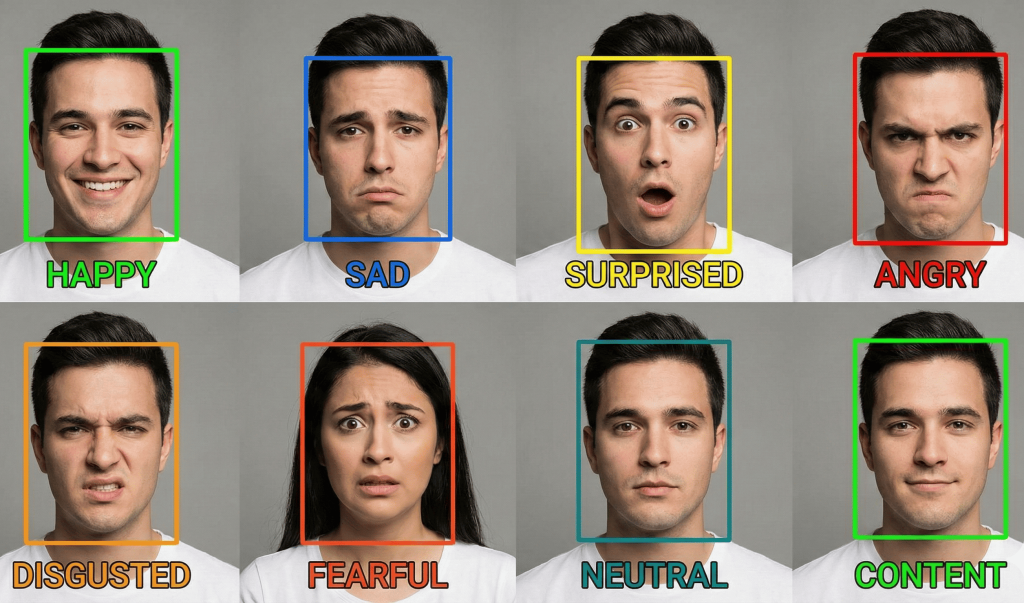
Artificial intelligence (AI) has made remarkable progress in understanding human behavior, but one of the most complex challenges remains interpreting emotions accurately. Sentimental AI, also known as Emotion AI, enables machines to recognize, interpret, and respond to human emotions, bridging this gap. From customer service to mental health monitoring, sentimental AI is revolutionizing how businesses interact with users.
However, the success of sentimental AI depends on high-quality data, accurately labeled to train models to recognize emotional cues effectively. High-quality data labeling is essential for AI systems to accurately classify sentiments across text, speech, images, and videos. In this blog, we’ll look into Sentimental AI’s operation, uses, difficulties, and how accurate data labeling supports its advancement.
What Is Sentimental AI?
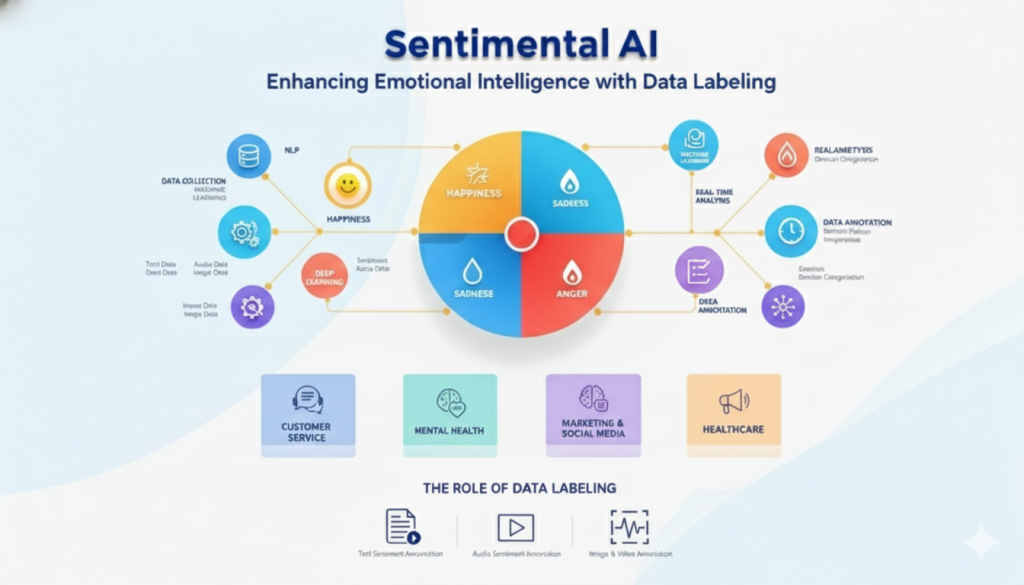
Sentimental AI is a subset of artificial intelligence that focuses on analyzing human emotions through text, voice, facial expressions, and physiological signals. It utilizes natural language processing (NLP), machine learning, and deep learning to interpret emotions such as happiness, sadness, anger, and surprise.
By integrating emotional intelligence, AI systems can make more informed decisions and improve human-AI interactions. Sentiment AI is used across multiple domains, including customer service, healthcare, marketing, and entertainment.
How Sentimental AI Works?
To understand human emotions, AI models rely on vast amounts of annotated data. The process involves:
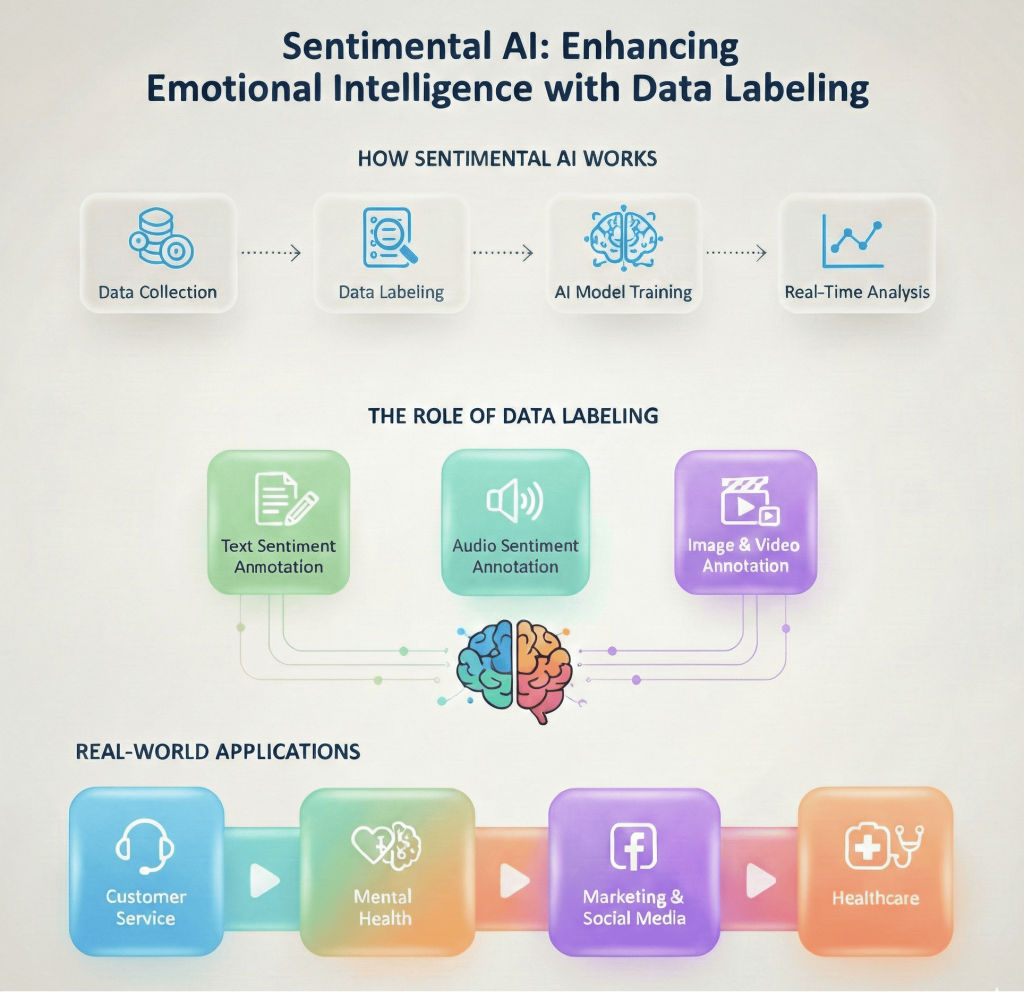
- Data Collection:
AI systems require diverse datasets that include text (customer reviews, social media comments), audio (speech tone, voice modulation), images (facial expressions), and videos (body language). - Data Labeling & Annotation:
Human annotators carefully label emotions within datasets using various techniques. Each data point is categorized based on sentiment polarity (positive, negative, or neutral) or a complex range of emotions. - Training AI Models:
AI models use supervised learning, where labeled datasets help train the system to recognize emotional cues. Techniques like convolutional neural networks (CNNs), recurrent neural networks (RNNs), and transformer models refine sentiment analysis. - Real-Time Sentiment Analysis:
Once trained, AI can analyze user input in real time, detecting emotional nuances and responding accordingly.
The Role of Data Labeling in Sentimental AI
Data labeling is crucial for the accuracy and reliability of Sentimental AI. Poorly labeled data can lead to incorrect emotion detection, negatively impacting AI applications. Let’s explore the different data annotation methods used for sentiment AI.
1. Text Sentiment Annotation
AI models analyze text-based data such as customer feedback, social media posts, chat messages, and emails. Human annotators label text with emotions, sarcasm, intent, and sentiment polarity.
For example:
- “This product is amazing!” → Positive Sentiment
- “I’m extremely disappointed with the service.” → Negative Sentiment
- “The experience was okay, nothing special.” → Neutral Sentiment
2. Audio Sentiment Annotation
Voice recordings are analyzed for tone, pitch, speech speed, and tone of voice to determine emotions. Data annotators listen to audio clips and label them based on detected emotions.
Example:
- A cheerful tone → Happiness
- A trembling voice → Fear or Anxiety
- A raised voice with fast speech → Anger
3. Image Sentiment Annotation
Facial recognition technology detects emotions based on expressions. Annotators use bounding boxes, keypoint annotation, and semantic segmentation to highlight facial features like eyebrows, mouth, and eyes to interpret emotions.
Example:
- Raised eyebrows and a smile → Happiness
- Furrowed brows and downturned lips → Sadness
4. Video Sentiment Annotation
Human emotions are often complex and require analyzing movements over time. Video annotation helps track facial expressions, body language, and gestures to provide a holistic sentiment analysis.
Example:
- A person leaning forward, nodding → Interest
- Crossed arms and frowning → Disapproval
Real-World Applications of Sentimental AI
1. Customer Experience & Chatbots
Businesses use sentimental AI in chatbots and virtual assistants to personalize responses based on customer emotions. AI-powered customer service tools can detect frustration and escalate the query to a human representative.
2. Mental Health Monitoring
AI can help detect early signs of depression or anxiety by analyzing voice patterns and facial expressions. Healthcare providers use sentimental AI for early diagnosis and emotional well-being assessments.
3. Marketing & Social Media Analysis
Brands analyze customer sentiment on social media to measure audience reactions to products, campaigns, and advertisements. Sentiment AI helps businesses refine their marketing strategies based on user emotions.
4. Education & E-Learning
AI-powered tutoring systems adapt to student emotions, identifying frustration, confusion, or boredom and adjusting teaching methods accordingly for a better learning experience.
5. HR & Employee Well-being
Organizations use AI to monitor employee satisfaction, burnout risks, and workplace morale by analyzing email tone, feedback, and video calls.
Challenges in Sentimental AI & Data Labeling
Despite its advancements, sentimental AI faces challenges in emotion detection and data labeling:
1. Subjectivity in Emotion Perception
Human emotions are complex, and different individuals may interpret the same situation differently. Annotators may label emotions inconsistently, affecting AI accuracy.
2. Language & Cultural Differences
Emotions vary across cultures. A phrase that sounds polite in one language may seem rude in another. Sentiment AI must be trained with multilingual and culturally diverse datasets.
3. Sarcasm & Irony Detection
AI struggles with sarcasm and irony since they focus on context. For instance:
- “Oh great, another Monday!” → Negative sentiment despite positive words.
4. Ethical & Privacy Concerns
Facial recognition-based sentiment analysis raises privacy concerns. Companies must ensure GDPR and HIPAA compliance when handling sensitive user data.
How Infolks Enhances Sentimental AI with Data Labeling
As a leading data labeling service provider, Infolks ensures high-quality labeled data for Sentimental AI. Our expert annotators deliver accurate, bias-free, and diverse sentiment-labeled datasets across text, audio, image, and video formats.
Why Choose Infolks?
- Multi-Format Labeling: From text sentiment analysis to facial expression annotation, we cover all data types.
- Triple-Level Quality Assurance: We maintain high annotation accuracy with strict quality control.
- Secure & Compliant: ISO 9001:2015, ISO/IEC 27001:2022 certified & GDPR-compliant data handling.
- Industry Expertise: Serving healthcare, finance, retail, and more for AI-driven sentiment analysis.
Final Thoughts
Sentimental AI is transforming human-AI interaction by embedding emotional intelligence into technology. However, its success depends on accurate and high-quality data labeling. With precise annotation, AI models can better understand human emotions, leading to enhanced customer experiences, improved mental health support, and more personalized interactions.
At Infolks, we support AI innovations with top-tier data labeling solutions. Looking to train your AI with precise emotion recognition? Partner with Infolks for high-quality data labeling.