
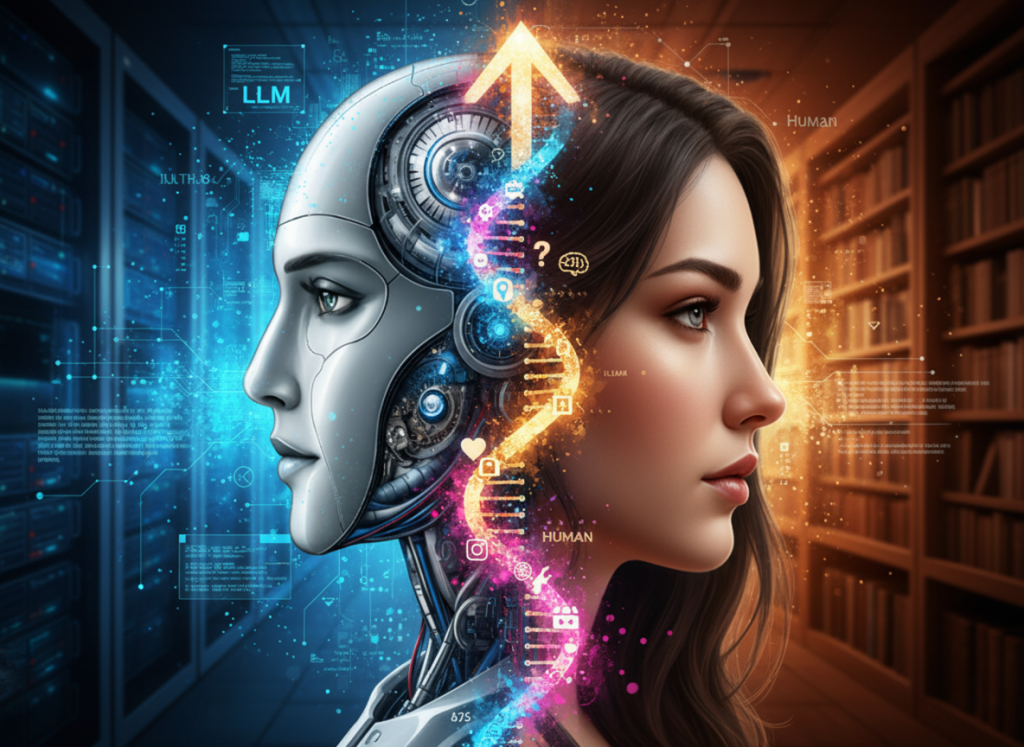
In the world of machine learning (ML) and artificial intelligence (AI), the idea of using large language models (LLMs) as evaluators or “judges” has gained traction. These AI-driven models are already powering numerous applications, from content generation to real-time translations. But how do they fare when it comes to the more nuanced process of evaluation? Can LLMs, when pitted against human evaluators, replace traditional judgment, or is there a more effective way to combine their strengths?
In this blog post, we will delve into the unique advantages and limitations of both LLMs and human evaluation and explore why combining the two could offer a groundbreaking solution to the challenges faced in evaluating AI outputs, content accuracy, and performance across industries.
The Rise of LLMs as Evaluators: What Are They?
Before we dive deeper, let’s first clarify what we mean by Large Language Models (LLMs). Large language models such as GPT-5 learn from extensive text datasets to deliver advanced AI capabilities. They have the ability to understand and generate human-like language, which makes them particularly effective for tasks like summarization, translation, and content generation. The evolution of LLMs has also made them a powerful tool for evaluation, providing objective insights on everything from grammar and syntax to content coherence.
LLMs analyze text, detect errors, suggest improvements, and predict how audiences may perceive information. When used as evaluators, they have the potential to automate processes traditionally handled by human evaluators, enabling faster and more consistent assessments.
Human Evaluation: The Human Touch in Judgment
Human evaluation, on the other hand, brings in a level of nuance that machines still struggle to replicate. Humans can assess a wide range of factors beyond just correctness, like emotional tone, context, creativity, and relevance. For example, when evaluating marketing content, a human judge can gauge whether the message will resonate with the target audience, taking into account psychological triggers, cultural references, and emotional appeal. LLMs, while powerful, may miss some of these subtleties.
Humans adapt quickly to new contexts and unfamiliar content, while LLMs operate within the limits of their training data. This is where human judgment is still irreplaceable, especially in industries requiring subjective assessments like advertising, writing, and even legal analysis.
LLMs vs. Human Evaluation: The Pros and Cons
Let’s break down the strengths and weaknesses of both approaches:
LLMs as Evaluators: Pros and Cons
Pros:
- Speed and Consistency: LLMs can evaluate vast amounts of content in seconds, providing instant feedback. Unlike humans, AI systems maintain consistent performance over time without fatigue.
- Scalability: In industries like customer service, content generation, or education, LLMs can evaluate and analyze large datasets quickly. something human evaluators would take a considerable amount of time to do.
- Data-Driven Insights: LLMs work off large datasets, ensuring that they provide data-driven, objective feedback. They are less prone to subjective biases and emotional responses.
Cons:
- Lack of Nuance: LLMs might miss out on the emotional tone, cultural context, or subtle humor present in the content. For instance, AI may misinterpret humor or sarcasm, leading to inaccurate evaluations.
- Dependence on Data: Training data limits what LLMs can understand and generate. If the dataset is incomplete or biased, the LLM’s judgments may reflect those biases.
- Lack of Creativity: While LLMs can mimic creative language patterns, they cannot inherently create original, innovative ideas like humans. The data and prompts you provide directly shape how creative they can be.
Human Evaluation: Pros and Cons
Pros:
- Contextual Understanding: Humans bring deep contextual understanding to their evaluations. They can assess the emotional undertone of a piece of content or understand ambiguous language in ways that LLMs can’t.
- Subjective Judgment: Humans excel at evaluating subjective factors like aesthetics, cultural relevance, and emotional appeal.
- Flexibility: Humans can adapt their judgment to new types of content or complex, unforeseen circumstances.
Cons:
- Inconsistency: Personal bias, emotions, or fatigue can influence human evaluators and reduce accuracy and consistency.
- Time-Consuming: Human evaluation takes time, especially when reviewing large volumes of data. This limits scalability in certain industries.
- Cost: Evaluation costs rise when organizations rely on human evaluators, especially for tasks that require specialized expertise.
The Case for Combining LLMs and Human Evaluation
Both LLMs and human evaluators bring distinct advantages to the table. But why should we choose one over the other when both have complementary strengths?
1. Speed Meets Accuracy
LLMs provide the speed and scalability that human evaluators cannot match. When human evaluators work alongside LLMs, they combine speed and judgment to deliver the best outcomes. The AI can quickly process large volumes of data, flagging potential issues or areas of improvement, while humans can step in to assess the subtleties, context, and creativity that the machine may miss.
2. Bias Reduction
LLMs can help reduce bias by providing objective evaluations based on data. However, human judgment often brings in personal biases. A combined approach ensures that AI can catch potential biases in human evaluations while allowing human evaluators to detect nuances that AI might miss.
3. Cost Efficiency
While LLMs may seem like a cheaper alternative to human evaluators, they still require careful training and fine-tuning to avoid errors. Using both allows businesses to save on the time and resources spent on training human evaluators while still benefiting from the insights that a human touch provides.
4. Addressing Complex Evaluation Criteria
Some types of evaluation simply require the human touch. For instance, industries like advertising, content creation, and legal analysis require human judgment because subjective evaluation goes beyond data points and logical patterns. AI is great at handling routine tasks, but when the stakes are higher, a blend of AI-powered analysis and human decision-making becomes indispensable.
Real-World Applications: How LLMs and Humans Work Together
Content Creation: AI-driven tools, powered by LLMs, can automatically evaluate blog posts, articles, or social media posts for grammatical accuracy, readability, and even SEO performance. Human editors can then refine the content, adjusting it for emotional impact, tone, and audience engagement.
Customer Service: AI can handle common queries, offering quick responses, while human agents step in when the conversation requires empathy or understanding of complex issues. This combination reduces wait times while maintaining the quality of customer support.
Legal Analysis: LLMs can help lawyers sift through large volumes of documents to identify key information or inconsistencies. However, when it comes to interpreting the law or understanding its broader impact, human legal experts still play a crucial role.
The Role of Data Labeling in AI Development
At Infolks, we play a key role in providing high-quality, accurate data that drives LLM training and evaluation. We ensure that the datasets used to train LLMs are diverse, balanced, and free from biases. In an age where both AI and human evaluations need to be in sync, reliable data labeling is essential for ensuring that both LLMs and human evaluators perform optimally.
Infolks’ precise data labeling services, which cover a wide range of formats including text, audio, image, and video, provide the foundation for AI systems to analyze and assess data effectively. We help companies achieve more accurate evaluations through AI or human input by training models with high-quality, labeled data.
Conclusion: Together Is Better
While both LLMs and human evaluators have their respective strengths, it’s clear that combining the two offers the most effective solution. The combination of speed, scalability, and data-driven insights from AI, coupled with the emotional intelligence, contextual understanding, and creativity of human evaluators, results in more accurate, comprehensive, and nuanced evaluations.
In the rapidly evolving landscape of AI and machine learning, the synergy between LLMs and human judgment is not just a possibility, it’s the future of evaluation.
Need precise data labeling to power your AI models?
Partner with Infolks to ensure your data is accurate, high-quality, and ready to enhance both AI and human evaluations. Get in touch today!