
Artificial intelligence is transforming industries faster than ever before. From healthcare and finance to autonomous vehicles and generative AI, businesses are increasingly relying on AI systems to automate processes, improve efficiency, and make smarter decisions.
But behind the rapid growth of AI lies a major challenge that many organizations still overlook: AI hallucination.
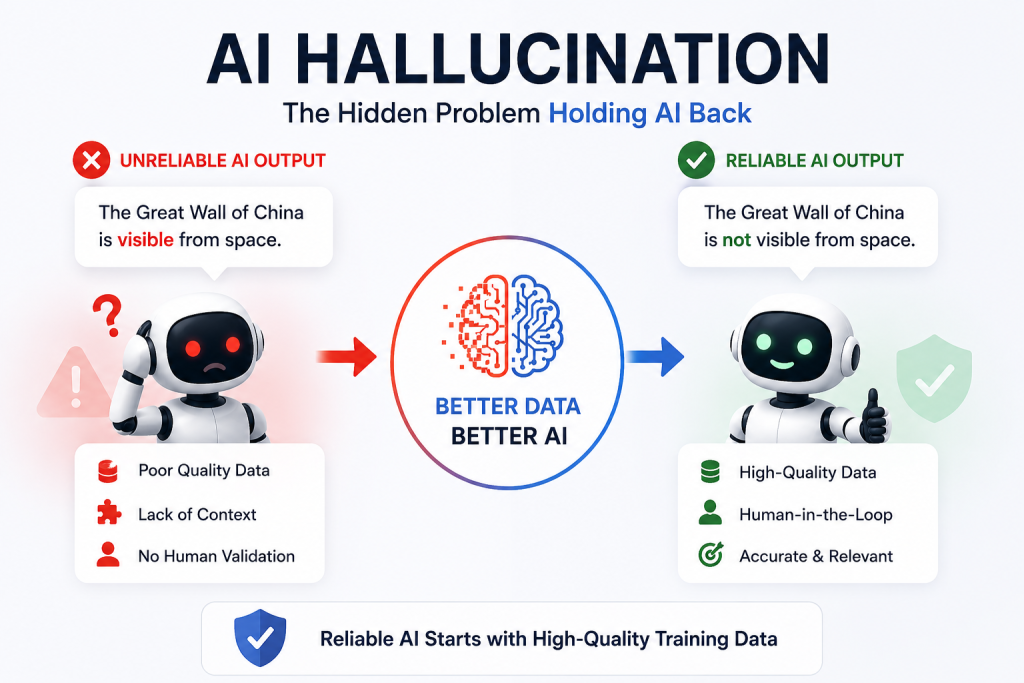
AI hallucination occurs when an AI system generates false, misleading, or completely fabricated information while sounding highly confident. The output may appear accurate, but in reality, it can be incorrect or unreliable. As AI becomes more integrated into real-world business operations, hallucinations are becoming a serious concern for companies across industries.
The truth is simple:
Even the most advanced AI model is only as reliable as the data it learns from.
That is why accurate training data and high-quality annotation are becoming the foundation of trustworthy AI systems.
What is AI Hallucination?
AI hallucination refers to situations where an AI model produces inaccurate or fabricated outputs that do not align with real-world facts or context. Unlike traditional software errors, hallucinations are often difficult to detect because AI systems present information with confidence.
This issue is commonly seen in:
- Large Language Models (LLMs)
- Generative AI systems
- AI chatbots
- Computer Vision applications
- Speech recognition models
For example, a chatbot may generate incorrect answers, an AI assistant may invent nonexistent references, or an autonomous system may misidentify objects in its environment. In critical industries like healthcare or finance, such errors can create significant risks.
Why Do AI Models Hallucinate?
AI models do not truly “understand” information like humans do. They identify patterns based on the data they are trained on. When training datasets contain inconsistencies, missing context, or poor-quality annotations, the AI learns inaccurate patterns, increasing the chances of hallucination.
One of the biggest reasons behind hallucinations is poor-quality training data. If datasets contain incorrect labels, duplicate information, or insufficient edge-case examples, the AI struggles to generate reliable outputs. Simply put, flawed data leads to flawed AI behavior.
Another major factor is the lack of human validation. While automation has accelerated AI development, human expertise is still essential for identifying ambiguities, correcting contextual errors, and ensuring annotation accuracy. Human-in-the-loop workflows play a crucial role in reducing hallucinations and improving overall AI reliability.
AI systems also struggle when exposed to situations they were never trained to handle. Real-world environments are unpredictable, and models require diverse datasets that include variations in language, lighting, behavior, audio quality, and object positioning. Without these scenarios, AI systems can make inaccurate assumptions.
The Business Impact of AI Hallucination
Many businesses still treat hallucinations as minor technical issues, but the impact can be far more serious. Inaccurate AI outputs can damage customer trust, affect decision-making, and create compliance or safety risks.
In healthcare, an incorrect AI-generated diagnosis could influence patient treatment decisions. In finance, hallucinated insights may lead to poor investment or operational choices. Customer service chatbots that provide inaccurate information can frustrate users and damage brand reputation.
Autonomous systems face even greater risks. A self-driving vehicle misclassifying a road object can directly affect safety and decision-making in real time.
As businesses continue adopting AI at scale, reliability is becoming one of the most important competitive advantages.
Why Better Data is the Real Solution
Many organizations focus heavily on improving AI models, but the real solution often lies in improving the data itself. The future of AI is increasingly becoming data-centric rather than model-centric.
High-quality datasets help AI systems:
- understand context more accurately
- reduce prediction errors
- improve consistency
- adapt to real-world environments
This is where professional data annotation becomes essential. Accurate annotation ensures that AI models learn from structured, contextual, and high-quality information rather than incomplete or noisy data.
Different AI applications require different forms of annotation expertise. Computer vision models depend on precise image and video annotation, while generative AI systems require high-quality text annotation and human feedback workflows. Autonomous systems rely heavily on accurate 3D point-cloud annotation to interpret their surroundings correctly.
Every annotation directly influences how AI understands the world.
The Importance of Human-in-the-Loop AI
Despite rapid advancements in automation, humans remain a critical part of AI development. Human-in-the-loop (HITL) systems combine machine efficiency with human judgment to improve annotation accuracy and contextual understanding.
Human validation helps:
- identify edge cases
- reduce hallucinations
- improve quality assurance
- maintain contextual consistency
AI can recognize patterns, but humans provide meaning and judgment. That balance is essential for creating reliable and scalable AI systems.
As generative AI continues to evolve, businesses are increasingly realizing that automation alone is not enough. Human expertise remains one of the most valuable components in AI training workflows.
The Growing Demand for High-Quality AI Training Data
Modern AI systems are becoming more advanced and data-hungry. Businesses now require:
- multimodal datasets
- multilingual annotation
- industry-specific expertise
- scalable QA processes
- real-time validation workflows
As AI adoption grows, the demand for accurate and reliable training data will continue increasing across industries.
Organizations are beginning to understand that better AI does not simply come from larger models. It comes from better data quality, stronger annotation processes, and continuous validation.
The Future of AI Depends on Better Data
AI hallucination is not just an AI problem. It is fundamentally a data problem.
As generative AI, autonomous technologies, and intelligent automation continue shaping the future, businesses must prioritize high-quality datasets, human validation, and scalable annotation workflows.
Companies that invest in data quality today will build more reliable, accurate, and trustworthy AI systems tomorrow.
Build Reliable AI with Infolks
At Infolks, we help businesses create accurate and scalable AI training datasets through expert annotation and human-in-the-loop workflows.
With experienced annotation teams, multi-level quality assurance, and industry-specific expertise, Infolks helps businesses reduce AI hallucinations and improve model performance with high-quality training data.
Looking to build more reliable AI systems?