
Artificial Intelligence (AI) is no longer limited to chatbots or virtual assistants. Today, AI can analyze data, automate workflows, write code, and support business decisions. As organizations adopt more advanced AI solutions, relying on a single AI model is becoming less practical.
Imagine an online retail business. One AI assistant answers customer questions, another tracks inventory, another processes payments, and another monitors deliveries. Instead of expecting one AI to perform every task, multiple specialized AI agents work together.
This approach is known as a multi-agent system (MAS).
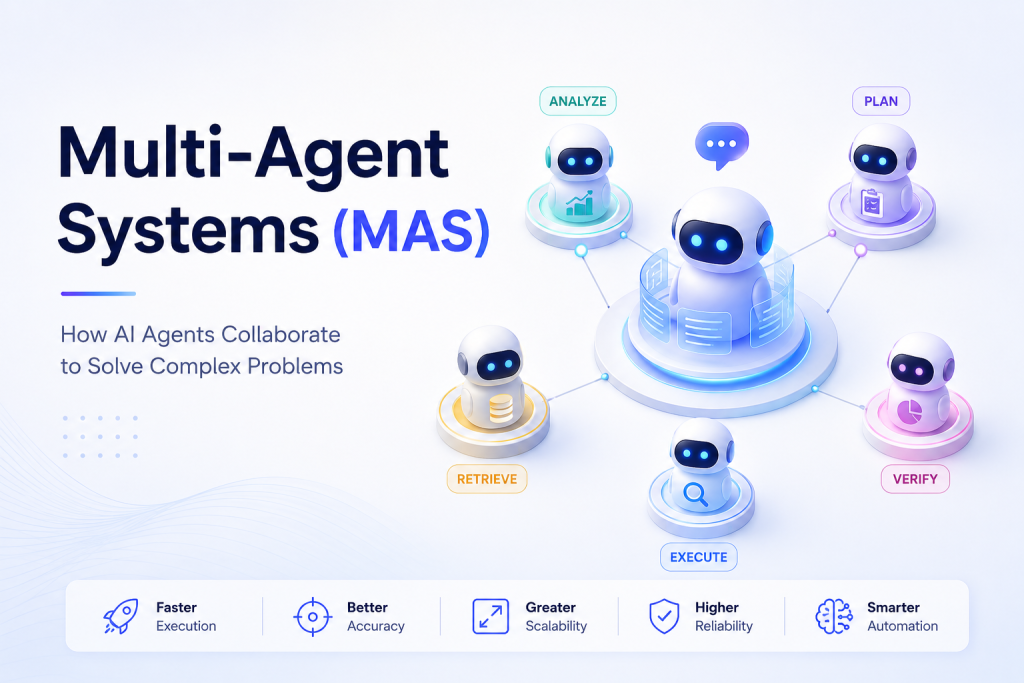
A multi-agent system consists of multiple AI agents that collaborate, communicate, and share responsibilities to complete complex tasks more efficiently. As agentic AI continues to grow, multi-agent systems are becoming the foundation for enterprise automation, intelligent assistants, robotics, and autonomous business operations.
What Is a Multi-Agent System (MAS)?
A multi-agent system (MAS) is a group of independent AI agents working together toward a common objective.
Each agent has a specific role and can make decisions, access information, and perform assigned tasks. Instead of one AI handling everything, work is divided among specialized agents.
Think of a hospital. Doctors diagnose patients, nurses monitor recovery, pharmacists prepare medication, and lab technicians perform tests. Each professional contributes unique expertise, creating a more effective healthcare system.
Multi-agent systems follow the same principle. Every AI agent specializes in a particular task while collaborating with others to achieve the best outcome.
How Do Multi-Agent Systems Work?
A multi-agent system typically follows these steps:
1. The User Makes a Request
For example:
“Generate this month’s sales performance report.”
2. The Task Is Divided
A coordinator agent analyzes the request and breaks it into smaller tasks.
3. Specialized Agents Perform Individual Tasks
Each AI agent handles a specific responsibility.
For example:
- A CRM agent retrieves customer information.
- A sales agent analyzes performance.
- An analytics agent identifies trends.
- A reporting agent prepares the final report.
4. Agents Share Information
The agents exchange results, verify information, and coordinate their progress to ensure consistency.
5. Final Response
The completed work is combined into a single response and presented to the user.
This collaborative approach allows AI to solve problems that would be difficult for a single model.
Benefits of Multi-Agent Systems
Faster Task Execution
Multiple AI agents work simultaneously, reducing the time required to complete complex tasks.
Better Specialization
Each agent focuses on a specific function, leading to improved accuracy and efficiency.
Greater Scalability
Organizations can introduce new AI agents as business requirements grow without redesigning the entire system.
Higher Reliability
Agents can validate one another’s outputs, reducing errors and improving decision quality.
Smarter Automation
Businesses can automate complete workflows instead of isolated tasks.
Real-World Applications
Multi-agent systems are transforming many industries.
Healthcare
AI agents analyze medical images, review patient records, schedule appointments, and support clinicians.
Finance
Different agents detect fraud, assess financial risk, monitor transactions, and generate compliance reports.
Retail
AI agents manage inventory, forecast demand, personalize recommendations, and improve customer service.
Manufacturing
Agents monitor equipment, predict maintenance needs, optimize production schedules, and identify quality issues.
Software Development
AI agents generate code, review security, create documentation, and perform automated testing.
Logistics
Multiple agents optimize delivery routes, monitor warehouse operations, and improve supply chain efficiency.
Challenges of Multi-Agent Systems
Although multi-agent systems offer significant advantages, they also introduce challenges.
Organizations must effectively manage communication between AI agents, coordinate tasks efficiently, ensure secure access to data, resolve decision conflicts, minimize response latency, and maintain data consistency across the entire system. Addressing these challenges is essential for building reliable, scalable, and high-performing multi-agent systems.
Building an effective multi-agent system requires both intelligent architecture and reliable data.
Why Data Quality Matters
Even the most advanced AI agents cannot deliver accurate results without high-quality data.
When multiple agents collaborate, they rely on the same information. If the data is incomplete, inconsistent, or inaccurate, the entire system can be affected.
To build reliable Multi-Agent Systems, organizations should prioritize accurate data labeling, high-quality annotation, human quality assurance, well-structured datasets, and reliable metadata. Together, these elements help AI agents understand context, retrieve relevant information, make better decisions, and collaborate more effectively.
These elements help AI understand context, retrieve relevant information, and make better decisions.
The Role of Data Labeling
Data labeling gives AI agents the context they need to interpret information consistently.
For example, when products, customer names, locations, and technical terms are accurately labeled, every AI agent understands the same information. This improves collaboration, search accuracy, entity recognition, and decision-making while reducing errors and hallucinations.
Whether developing enterprise assistants, autonomous systems, or intelligent workflows, quality data remains the foundation of reliable AI.
Building Better AI with Infolks
As businesses adopt multi-agent systems, high-quality training data becomes increasingly important. Seamless collaboration between AI agents starts with accurate, structured, and well-annotated datasets.
At Infolks, we provide image, video, audio, text, and 3D point cloud annotation services that help organizations build dependable AI solutions. Our experienced annotation teams and rigorous quality assurance processes support AI development across healthcare, automotive, manufacturing, retail, logistics, agriculture, finance, and other industries.
By combining advanced AI technologies with high-quality training data, businesses can build AI systems that are accurate, scalable, and ready for real-world applications.
Conclusion
Multi-agent systems represent the next evolution of artificial intelligence. By enabling specialized AI agents to collaborate, organizations can automate complex workflows, improve decision-making, and increase operational efficiency.
However, successful AI collaboration depends on more than intelligent agents. It also requires accurate, well-structured, and high-quality data. Combining collaborative AI architectures with reliable data annotation helps businesses build AI systems that are trustworthy, scalable, and future-ready.
As AI continues to evolve, multi-agent systems will play a central role in shaping the future of enterprise AI, and quality training data will remain the foundation that makes it all possible.