
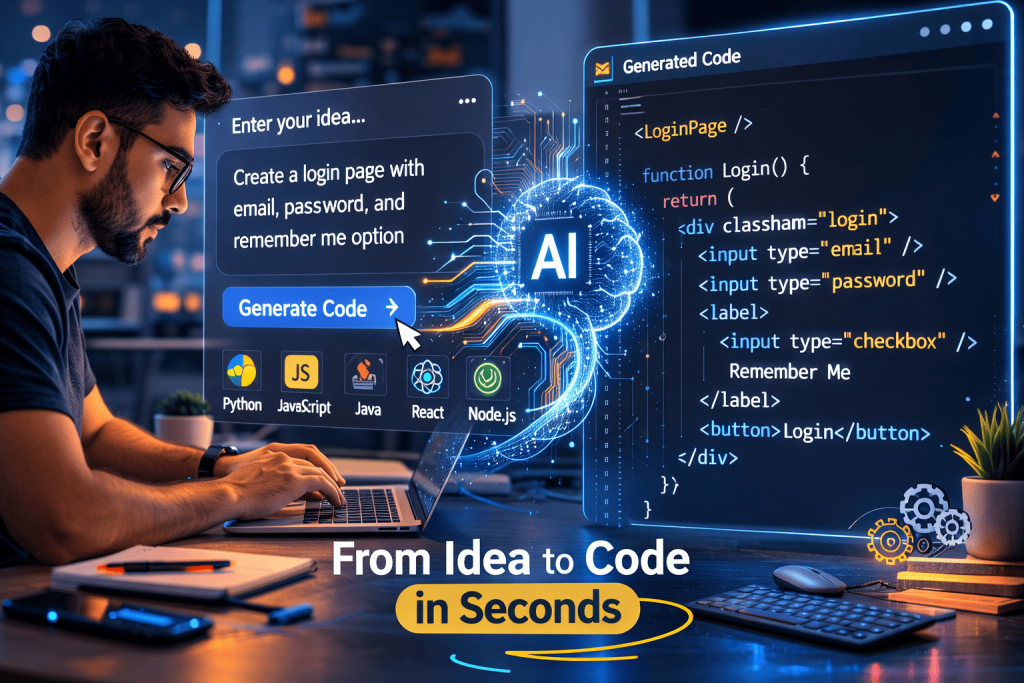
The software development landscape is evolving rapidly as artificial intelligence becomes an integral part of the coding process. AI coding assistants are transforming how developers write, test, and maintain software. Instead of spending hours writing repetitive code or searching documentation, developers can now collaborate with intelligent systems that generate suggestions, automate tasks, and improve coding efficiency.
These AI tools analyze massive datasets of programming languages, frameworks, and open source repositories to understand coding patterns. As a result, they can recommend solutions, detect bugs, and even generate entire code blocks. For developers and technology teams, this means faster development cycles, better productivity, and a more efficient workflow.
AI coding assistants are not replacing developers. Instead, they are becoming powerful collaborators who help engineers focus on solving complex problems rather than writing repetitive lines of code.
What Are AI Coding Assistants?
AI coding assistants are artificial intelligence tools designed to support developers during the software development lifecycle. These tools analyze the context of the code and provide real-time suggestions to help developers write, improve, and debug software.
Instead of coding everything manually, developers can describe what they want to build, and the AI generates relevant code suggestions.
Key capabilities of AI coding assistants include:
• Generating code from natural language instructions
• Autocompleting code snippets and entire functions
• Detecting potential bugs and vulnerabilities
• Suggesting optimized algorithms
• Explaining complex code snippets
These features make AI coding assistants function as virtual programming partners, helping developers write better code faster.
How AI Coding Assistants Work
AI coding assistants rely on machine learning models trained on millions of code examples from public repositories and developer documentation. These systems learn programming patterns, syntax rules, and best practices across multiple programming languages.
When developers write code, the AI analyzes the surrounding context, including variables, functions, and comments. It then predicts what the developer may want to write next and provides intelligent suggestions. The developer can accept, edit, or reject these suggestions depending on the project requirements.
Over time, these tools improve through feedback and usage patterns. The more developers interact with AI coding assistants, the more accurately they can generate helpful recommendations.
Why AI Coding Assistants Are Transforming Development
AI coding assistants are reshaping the way software development teams work. By reducing repetitive tasks and offering real-time suggestions, these tools significantly improve productivity.
Several key factors explain why developers are adopting AI-powered coding tools.
Faster Development Cycles
AI tools help automate repetitive coding tasks that traditionally consume developer time.
Examples include:
• Generating boilerplate code
• Writing basic functions and templates
• Creating database queries
• Building configuration files
This automation allows teams to deliver features faster and accelerate product development.
Improved Developer Productivity
AI coding assistants function like real-time collaborators inside the development environment.
They help developers:
• Complete code faster
• Discover better solutions
• Reduce time spent searching documentation
• Avoid common coding mistakes
As a result, developers can focus more on architecture design and complex problem-solving rather than routine coding tasks.
Better Code Quality
Maintaining accurate, efficient, and scalable code is critical for modern software development. It significantly improve code quality by analyzing patterns and suggesting improvements throughout development. These tools can detect inefficient logic, recommend optimized solutions, and guide developers toward better coding practices.
Instead of discovering problems later during testing, developers receive immediate feedback while writing code. AI can highlight potential errors, suggest improvements in structure, and ensure consistency across the codebase. This proactive approach helps teams maintain higher quality standards and reduces the risk of technical debt.
As software projects grow more complex, maintaining code quality becomes increasingly challenging. AI-powered assistance helps developers manage complexity while ensuring that applications remain stable, efficient, and maintainable.
Faster Debugging and Testing
Debugging is often one of the most time-consuming aspects of software development. AI coding assistants can significantly speed up this process by identifying issues early in the development stage.
These tools help developers by:
• Detecting syntax errors instantly
• Highlighting logical inconsistencies
• Identifying potential security vulnerabilities
• Suggesting fixes for broken code
This allows developers to resolve issues quickly and reduce the time spent troubleshooting complex problems.
A Learning Tool for Developers
AI coding assistants are also valuable learning resources, especially for developers who are exploring new programming languages or frameworks.
Developers can use AI tools to:
• Understand unfamiliar code structures
• Generate examples for programming concepts
• Explore alternative coding approaches
• Learn best practices from AI-generated suggestions
This makes AI assistants useful for both experienced engineers and beginners entering the programming field.
Popular AI Coding Assistants
Several AI-powered coding tools have gained popularity among developers.
Some widely used AI coding assistants include:
• GitHub Copilot
• Amazon CodeWhisperer
• Tabnine
• Replit Ghostwriter
• Codeium
These platforms offer features such as:
• Real-time code generation
• Intelligent code completion
• AI-powered debugging support
• Automated documentation assistance
Many development teams now integrate these tools directly into their coding environments.
Challenges of AI Coding Assistants
Despite their advantages, it also present certain limitations that developers must consider.
Common challenges include:
• AI-generated code may sometimes contain errors
• Security vulnerabilities can appear in generated code
• Overdependence on AI may weaken core coding skills
Developers must carefully review AI-generated suggestions and maintain strong programming fundamentals.
The Future of AI Coding Assistants
AI coding assistants are still evolving, and their capabilities will continue to expand in the coming years. Future innovations are expected to move beyond simple code suggestions toward more autonomous development capabilities.
Emerging trends may include:
• AI systems capable of building full applications
• Autonomous AI agents that write and deploy code
• Intelligent development environments powered by AI
• Automated debugging and optimization tools
These advancements will allow developers to focus more on strategic thinking and system design rather than repetitive coding tasks.
Infolks Data Labeling Services for AI Development
Building advanced AI systems, such as coding assistants, requires more than powerful algorithms. The true foundation of these technologies is high-quality training data. AI models learn programming logic, developer behavior, and coding patterns by analyzing large volumes of structured datasets.
To make these datasets usable for machine learning models, they must be carefully prepared and labeled. This is where data labeling and annotation services play a crucial role in AI development.
At Infolks, we help AI companies, startups, and technology teams prepare high-quality datasets that power intelligent AI systems. Our services support organizations that are developing next-generation AI applications, including AI coding assistants, developer copilots, and intelligent automation tools.
Our data labeling solutions include:
• Code dataset annotation for machine learning models
• Text and NLP data labeling for developer prompts
• Dataset preparation for training large language models
• Human-in-the-loop validation to improve model accuracy
• Quality assurance processes for reliable AI training data
By combining human expertise with scalable workflows, Infolks helps AI teams build strong data foundations for their models.
How Infolks Helps AI Builders Train AI Coding Assistants
For AI coding assistants to work effectively, models must understand programming syntax, logic structures, and developer instructions. Training such systems requires massive datasets that represent real coding environments and programming scenarios.
Infolks helps AI builders create these datasets through structured annotation processes designed specifically for machine learning pipelines.
Our approach enables AI companies to train models that can:
• Generate accurate code suggestions
• Understand natural language programming instructions
• Detect bugs and vulnerabilities in code
• Assist developers with debugging and optimization
By delivering well-structured and accurately labeled datasets, Infolks helps organizations accelerate the development of AI-powered coding assistants and intelligent development tools.
As AI continues to transform the software development industry, demand for reliable training data is growing rapidly. AI builders need trusted data partners who can provide scalable, high-quality datasets for model training.
Infolks supports this innovation by delivering data labeling services that help AI teams build smarter, more reliable AI systems for the future of programming.
Conclusion
AI coding assistants are reshaping the future of programming by improving productivity, enhancing code quality, and accelerating development workflows. These tools enable developers to collaborate with intelligent systems that generate code, detect errors, and automate routine tasks.
The future of programming will not be about AI replacing developers. It will be about developers using AI to build smarter, faster, and more innovative software solutions.
However, every powerful AI system depends on one critical element, high-quality training data. AI models such as coding assistants rely on accurately labeled datasets to understand programming logic, developer instructions, and real-world coding patterns.
Infolks supports this innovation by helping AI companies build reliable AI models through scalable data labeling and annotation services.
Ready to build smarter AI models?
If you are developing AI solutions and need high-quality training data, Infolks can help accelerate your AI development journey.
Contact Infolks today to explore how our data labeling services can help you build the future of intelligent software.