
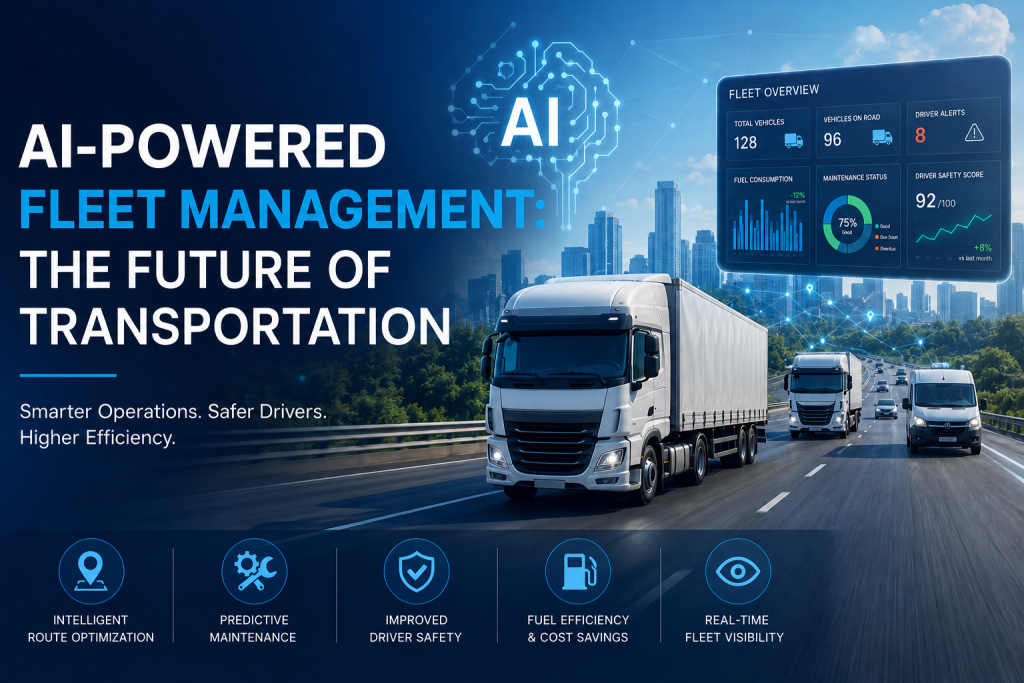
The transportation industry is rapidly evolving. Businesses are increasingly adopting advanced technologies to improve efficiency and reduce operational costs. Among these innovations, AI-powered fleet management is emerging as a game-changer.
Fleet operators face growing challenges every day. Rising fuel prices, vehicle maintenance costs, driver safety concerns, and customer expectations create significant pressure. Therefore, organizations are turning to artificial intelligence to optimize operations and gain a competitive advantage.
AI is no longer a futuristic concept. Instead, it is becoming a critical component of modern transportation systems.
What Is AI-Powered Fleet Management?
AI-powered fleet management uses artificial intelligence, machine learning, and data analytics to monitor and optimize fleet operations.
The technology collects data from GPS devices, onboard sensors, telematics systems, cameras, and connected vehicles. This information is then analyzed to generate valuable insights.
Consequently, fleet managers can make faster and more informed decisions. Furthermore, many routine tasks can be automated, allowing teams to focus on strategic operations.
Why AI Is Transforming Fleet Operations
Traditional fleet management often relies on manual processes and reactive decision-making. However, AI enables a proactive approach.
By continuously analyzing large volumes of data, AI can identify patterns, predict future events, and recommend optimal actions.
As a result, transportation companies can improve productivity while reducing operational risks.
Key Benefits of AI-Powered Fleet Management
Intelligent Route Optimization
Efficient routing is essential for reducing delivery times and transportation costs.
AI analyzes traffic conditions, weather patterns, road closures, and historical travel data in real time. Therefore, it can identify the most efficient routes for each vehicle.
Consequently, fuel consumption is reduced, delivery schedules are improved, and customer satisfaction increases.
Predictive Maintenance
Vehicle breakdowns can disrupt operations and create unexpected expenses.
AI-powered systems continuously monitor engine performance, component health, and maintenance records. Potential issues can be detected before major failures occur.
As a result, maintenance can be scheduled proactively rather than reactively. This approach reduces downtime and extends vehicle lifespan.
Improved Driver Safety
Driver behavior has a direct impact on fleet performance and safety.
AI systems can monitor speeding, harsh braking, rapid acceleration, distracted driving, and fatigue indicators.
Furthermore, managers receive actionable insights that support driver coaching and training programs.
Consequently, accident risks can be reduced while overall safety standards improve.
Fuel Efficiency and Cost Savings
Fuel represents a significant portion of fleet operating expenses.
AI helps identify inefficient driving patterns and unnecessary fuel consumption. Additionally, optimized routes contribute to lower fuel usage.
Therefore, businesses can reduce costs while supporting sustainability goals.
Real-Time Fleet Visibility
Modern transportation requires complete operational visibility.
AI-powered platforms provide real-time tracking of vehicles, assets, and deliveries. Managers can instantly access important information from a centralized dashboard.
As a result, decision-making becomes faster and more effective.
AI Applications in Transportation
AI-powered fleet management supports a wide range of transportation applications.
For example, logistics companies use AI to improve delivery planning and warehouse coordination. Public transportation providers use AI to optimize schedules and passenger experiences.
Similarly, autonomous vehicle developers rely on AI to navigate complex environments safely.
Additionally, fleet operators can use AI-driven insights to improve resource allocation and maximize asset utilization.
The Importance of High-Quality Data
Artificial intelligence depends entirely on data.
Even the most advanced algorithms cannot perform effectively without accurate and reliable information. Therefore, high-quality data is the foundation of every successful AI-powered fleet management system.
Transportation fleets generate massive amounts of data daily. This data includes GPS records, vehicle telemetry, maintenance logs, sensor outputs, traffic information, and video footage.
However, raw data alone is not enough.
Data must be collected, organized, annotated, and validated before AI models can learn from it effectively. Otherwise, inaccurate data may lead to poor predictions and unreliable outcomes.
Consequently, organizations investing in fleet AI must prioritize data quality from the beginning.
Why Data Annotation Matters
Many fleet management applications rely on computer vision and machine learning technologies.
For instance, driver monitoring systems must identify signs of fatigue and distraction. Traffic analysis platforms must recognize vehicles, road signs, pedestrians, and lane markings.
Likewise, predictive maintenance models require accurately labeled historical datasets to identify patterns and forecast equipment failures.
Without proper data annotation, AI systems may struggle to achieve the accuracy required for real-world deployment.
Therefore, precise and consistent labeling plays a vital role in transportation AI success.
How Infolks Powers Transportation AI
Building reliable fleet intelligence solutions requires high-quality training data.
Infolks supports transportation and mobility companies through expert data annotation and training data services.
The company provides image, video, audio, text, and 3D point cloud annotation for machine learning applications.
For transportation projects, Infolks helps create accurate datasets for:
- Fleet monitoring systems
- Driver behavior analysis
- Predictive maintenance models
- Traffic management platforms
- Autonomous vehicle development
- Smart mobility solutions
Moreover, Infolks follows strict quality assurance processes to ensure data accuracy, consistency, and reliability.
As a result, organizations can train AI models with confidence and accelerate innovation across transportation operations.
The Future of Transportation
The future of transportation will be increasingly intelligent, connected, and automated.
AI-powered fleet management will continue driving improvements in efficiency, safety, sustainability, and customer experience.
Furthermore, advances in machine learning, computer vision, IoT, and connected infrastructure will unlock new possibilities for transportation networks worldwide.
Organizations that embrace AI today will be better prepared for tomorrow’s challenges.
However, successful AI implementation begins with one essential ingredient: high-quality training data.
Conclusion
AI-powered fleet management is reshaping the transportation industry through smarter decision-making and operational efficiency.
From predictive maintenance to route optimization, AI delivers measurable business value across every stage of fleet operations.
Nevertheless, the effectiveness of these systems depends on accurate and well-annotated data.
If your organization is building next-generation transportation solutions, partnering with a trusted data annotation provider is crucial.
Accelerate Your Transportation AI Journey with Infolks
Infolks delivers high-quality training data and annotation services that help transportation companies build reliable AI solutions faster. Contact our team today to transform your fleet data into actionable intelligence and drive the future of transportation.